Social Media Scheduling APIs for Developers (2026)
Updated September 2026 · hands-on tested by the Breakreach team
In short: For developers who need programmatic social publishing in 2026: Zernio is the modern per-account-priced API (2 accounts free, then $6 → $1/account at scale, 16 platforms + ads), Breakreach is the best value for indie builders and agent developers (2 free accounts, then $5/account, deepest per-platform publishing handling, hosted MCP server), Ayrshare is the mature enterprise choice (from ~$149/month, unmatched hardening), and self-hosted Postiz is the $0-fees option if you'll own every platform's app review. Buffer's API is closed to new use cases and shouldn't anchor a new project.
Building social publishing into a product used to mean a brutal choice: integrate a dozen platform APIs, each with its own OAuth dialect, app-review process, media specs and undocumented failure modes, or bolt on a unified API and accept its constraints. The unified-API category has since matured into real infrastructure, and 2026 added a twist that reshapes the evaluation: AI agents are now API consumers. That means MCP servers, OpenAPI specs and llms.txt files are no longer nice-to-haves; for many products, the "developer" reading your docs is a model.
This comparison is written from production experience, and it front-loads the criterion that actually separates these services: how much platform pain they absorb. Publishing "to Instagram" sounds like one API call; in practice it's a professional-account requirement, media-format constraints, a container-then-publish flow, token refreshes on 60-day cycles, and error codes that change meaning by context. Multiply by twelve platforms. The services below all promise one request shape; they differ enormously in what happens when TikTok rejects your PNG or a subreddit demands a flair.
We compare four realistic options, Ayrshare, Zernio, Breakreach and self-hosted Postiz, on request ergonomics, edge-case handling, agent-readiness, and modeled total cost at 2, 25 and 100 connected accounts.
Total monthly cost by connected accounts
Modeled from published September 2026 pricing. "Accounts" = social profiles connected for publishing.
| Accounts | Breakreach (dev plan) | Zernio | Ayrshare | Postiz self-hosted |
|---|---|---|---|---|
| 2 (prototype) | $0 | $0 | $0 (dev tier) | ~$8 VPS + your hours |
| 10 | $40 (8 × $5) | $48 (8 × $6) | ~$149 | ~$8 + hours |
| 25 | $105 (18×$5 + 5×$3) | $93 (8×$6 + 15×$3) | ~$149+ | ~$16 + hours |
| 100 | $330 | $228 | custom | ~$25 + hours |
| 500 | $1,130 | $628 | custom | ~$50 + serious hours |
Capability matrix
| Feature | Breakreach | Zernio | Ayrshare | Postiz (self-hosted) |
|---|---|---|---|---|
| Platforms | 12 | 16 + ads networks | 13+ | ~14 (your credentials) |
| Platform app reviews handled for you | ✅ | ✅ | ✅ | ❌ all yours |
| Hosted MCP server | ✅ (OAuth 2.1 + API keys) | ✅ | ✅ | Self-hosted |
| OpenAPI spec public | ✅ /v1/openapi.json | ✅ | ✅ | ✅ (repo) |
| llms.txt for agents | ✅ | ✅ | ✗ | ✗ |
| Scheduling engine (server-side + retries) | ✅ incl. transient-error retries | ✅ | ✅ | Your infra |
| TikTok photo auto-conversion | ✅ | ✗ | ✗ | ✗ |
| Reddit flair discovery/selection | ✅ | ✗ | ✗ | Partial |
| Media re-hosting for scheduled posts | ✅ | ✅ | ✅ | Yours |
| Analytics endpoints | ✅ per-post + per-account | ✅ | ✅ | Partial |
| Comments read/reply API | ✅ (IG/FB/Threads/X) | ✅ | ✅ | ✗ |
| Ads campaign APIs | ✗ | ✅ (7 networks) | ✗ | ✗ |
| White-label / multi-tenant | Workspaces | ✅ | ✅ (strongest) | DIY |
| End-user dashboard included | ✅ full product | ✗ | Minimal | ✅ |
The tools, in depth
1. Zernio, The modern unified API, priced per connected account
Best for: Products and agent platforms scaling from prototype to fleet
Pricing: First 2 accounts free; $6/account/month, $3 from 11 accounts, $1 from 101
Platforms: 16 incl. WhatsApp, Snapchat, Google Business + 7 ads networks
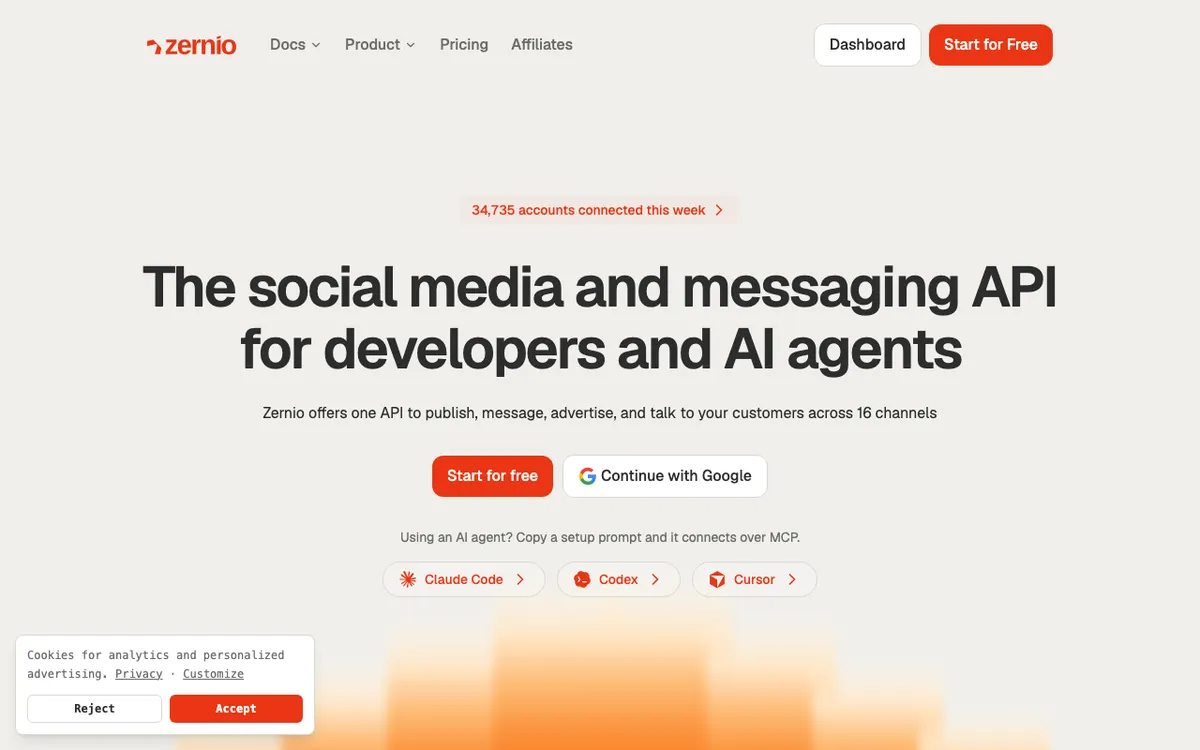
Zernio reads like the API a 2026 team would design from scratch, because it is one: REST plus a hosted MCP server, sixteen platforms and seven ads networks behind a single request shape, and a pricing model (per connected account, steeply degressive) that maps exactly onto how agencies and platform-builders actually grow. Two accounts free makes the prototype phase costless; the $1/account tier above 100 makes fleet economics work where workspace-priced competitors would charge multiples more.
The ads APIs deserve emphasis because nothing else in this comparison has them: if your product needs to create or manage paid campaigns programmatically alongside organic posts, Zernio is currently the only unified option, full stop. Combined with the breadth (WhatsApp and Google Business posting are similarly rare), it's the coverage champion.
The trade-offs are the mirror image. There's no dashboard for your customers, every review-and-approve surface is yours to build. And the publishing layer is faithful rather than opinionated: it will pass your PNG to TikTok and return TikTok's rejection, where an opinionated layer would have converted the image first. For teams with the engineering capacity to own those details, that neutrality is fine; teams that want them handled should read the next entry.
Pros
- +Broadest coverage in the category: 16 organic platforms plus ads campaign management (Meta, Google, TikTok, LinkedIn, Pinterest, X, and ChatGPT Ads)
- +One request shape and one auth model across everything
- +The best scale pricing here: 500 accounts ≈ $628/month
- +Docs engineered for agent consumption: OpenAPI, machine-readable rate card, LLM summaries, agent-skills index
Cons
- −Younger production track record than Ayrshare
- −No end-user dashboard: you build every pixel of UI
- −Per-platform publishing finesse (flairs, format conversion) left to the caller
2. Breakreach, The indie-friendly API where platform quirks come pre-handled
Best for: Indie developers and AI-agent builders who want cheap entry and production-grade publishing without owning the edge cases
Pricing: Developer plan: 2 connected accounts free, then $5/account (degressive: $3 from 21, $2 from 101); regular product plans from $23/month include API keys
Platforms: Instagram, TikTok, X, Reddit, LinkedIn, YouTube, Facebook, Threads, Bluesky, Pinterest, Telegram, Discord
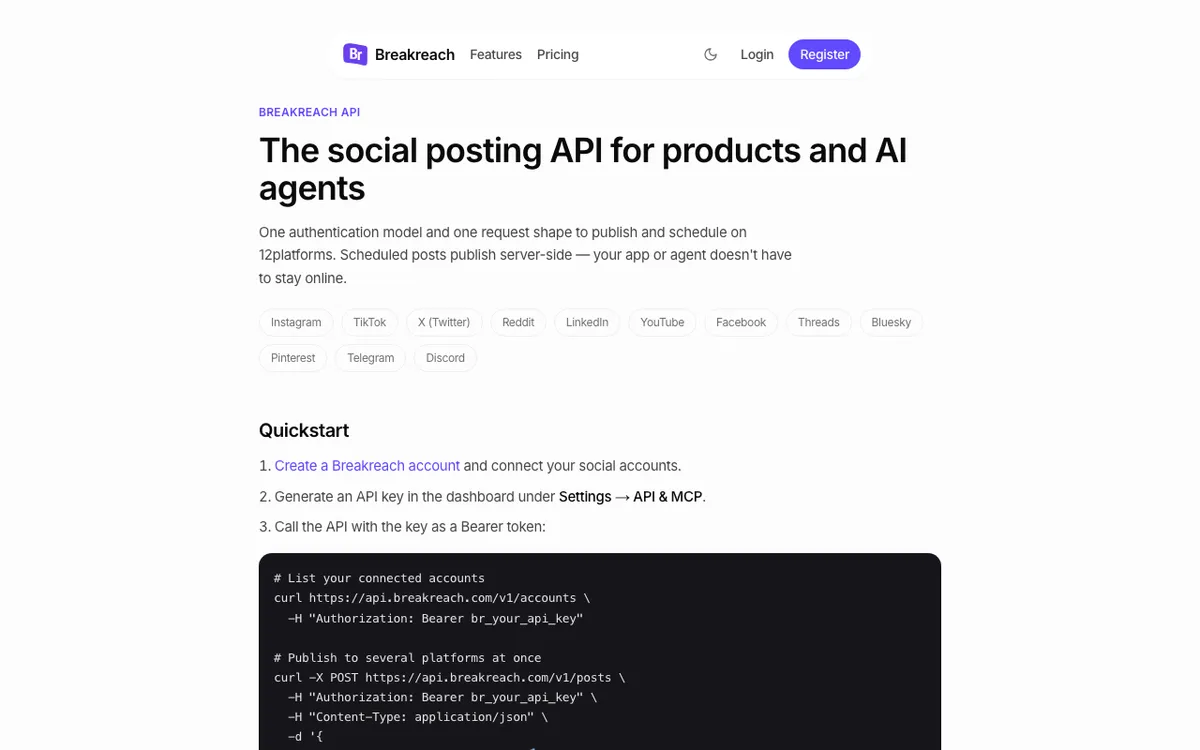
Breakreach arrives at the API market from an unusual direction: it's a consumer scheduling product whose entire backend: the same one driving its Claude and ChatGPT connectors, is exposed as a public REST API and MCP server. That heritage produces a distinctive strength: the publishing pipeline has been hardened by real consumer traffic across twelve platforms, and the lessons are baked in as defaults rather than left as exercises. Your API call posts a photo to TikTok? It gets converted to TikTok's required format automatically. Targets a flair-required subreddit? The flair endpoints are there, and the error message names the valid options if you skip them. Schedules media by URL? It's re-hosted immediately so the post can't break when the source link dies.
For AI-agent builders specifically, the error design is the killer feature. Agents recover from failures exactly as well as the error messages allow, and Breakreach's are written for that loop: human-readable, cause-plus-remedy, no raw platform JSON. Pair that with the hosted MCP server (so your agent doesn't even need REST glue) and the llms.txt/OpenAPI documentation, and it's the fastest path we measured from zero to an agent reliably publishing across platforms.
Price-wise it brackets Zernio: identical 2-free-accounts entry, $5 vs $6 per account in the 3-20 range (advantage Breakreach), crossing over at scale where Zernio's $1 tier wins (100 accounts: $330 vs $228). Below ~25 accounts, i.e. for most indie products, Breakreach is both the cheaper and the more forgiving choice; at fleet scale or when you need ads/WhatsApp, Zernio takes it.
Pros
- +The publishing layer is opinionated in the right places: TikTok images auto-converted to compliant JPEG, Reddit flairs fetched and applied, Instagram professional-account flow managed, media re-hosted so scheduled posts can't 404, automatic retries on transient errors
- +Errors come back as actionable prose ("r/webdev requires a flair, available: Discussion, Showoff…"), designed for agent recovery loops
- +Hosted MCP server (OAuth 2.1 with dynamic client registration; API keys also work as bearer tokens): the same one behind its ChatGPT/Claude directory connectors
- +OpenAPI spec + llms.txt published; an agent can genuinely self-integrate
- +Cheapest hosted entry: 2 accounts free, then $5/account
Cons
- −12 platforms vs Zernio's 16; no WhatsApp/Snapchat, no ads APIs
- −Multi-tenant/white-label story is workspaces, not a dedicated enterprise layer
- −Younger vendor
3. Ayrshare, The established enterprise social API
Best for: Funded companies where publishing failures cost real revenue
Pricing: Free tier for development; business plans from ~$149/month
Platforms: 13+
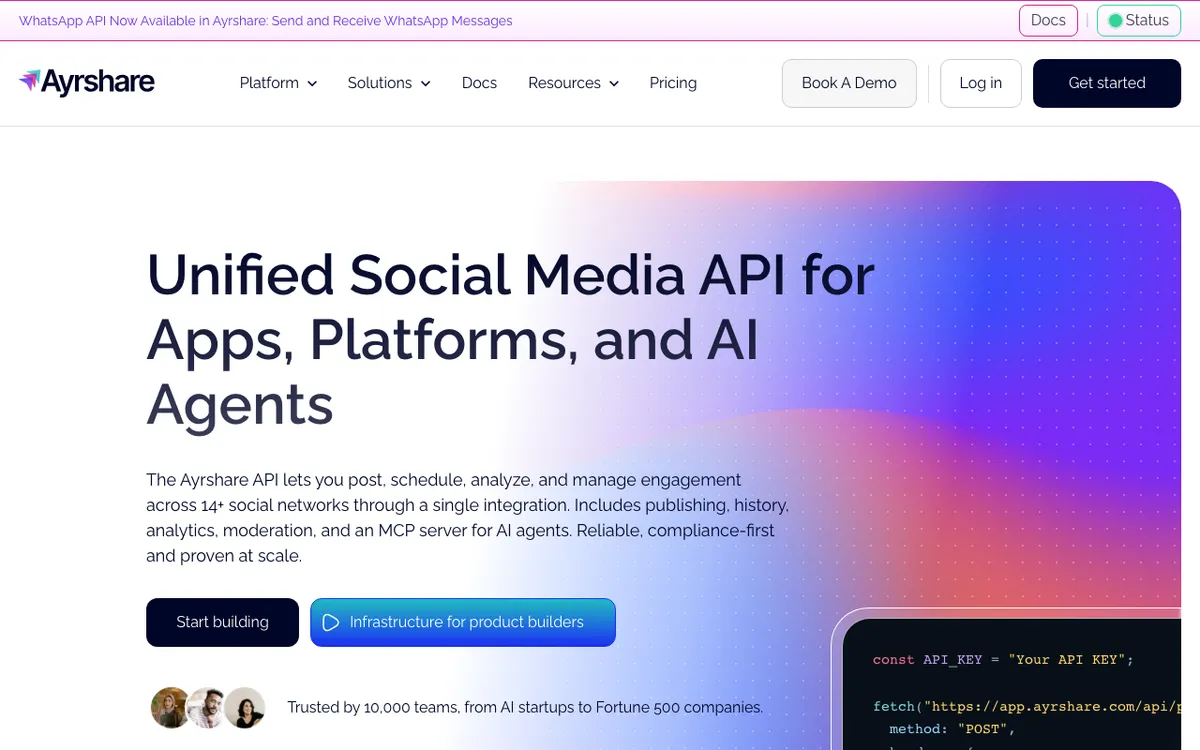
Ayrshare created this category and remains its safest enterprise pick. The moat is accumulated scar tissue: years of platform API changes absorbed, edge cases documented, SDKs matured, support processes proven. When a prospective customer's security team sends a questionnaire, Ayrshare has the answers on file and that, more than any feature, is what the ~$149/month entry buys.
The evaluation is honestly about your stage. A funded product where a day of publishing downtime costs real churn should weigh Ayrshare's maturity heavily; its white-label architecture is also the strongest here for building client-facing social products. An indie developer gets a comparable feature core elsewhere for a tenth of the price and should spend the difference on growth. Both readings are correct for their reader.
Pros
- +Years of production hardening, edge cases documented that competitors haven't met yet
- +The strongest white-label and multi-user-profile architecture for client-facing products
- +Real support SLAs, compliance answers, and the longest uptime track record in the category
Cons
- −Entry pricing (~$149/month) is 6-30× the modern competitors at small scale
- −API-era design, MCP and agent-readiness are additions, not foundations
- −Workspace-bundle pricing fits B2B contracts, not per-account growth
4. Postiz (self-hosted), Open-source: the API is yours, and so are the app reviews
Best for: Teams with infra capacity and data-sovereignty requirements
Pricing: Free (AGPL) self-hosted; cloud from ~$29/month
Platforms: ~14, gated on credentials you obtain
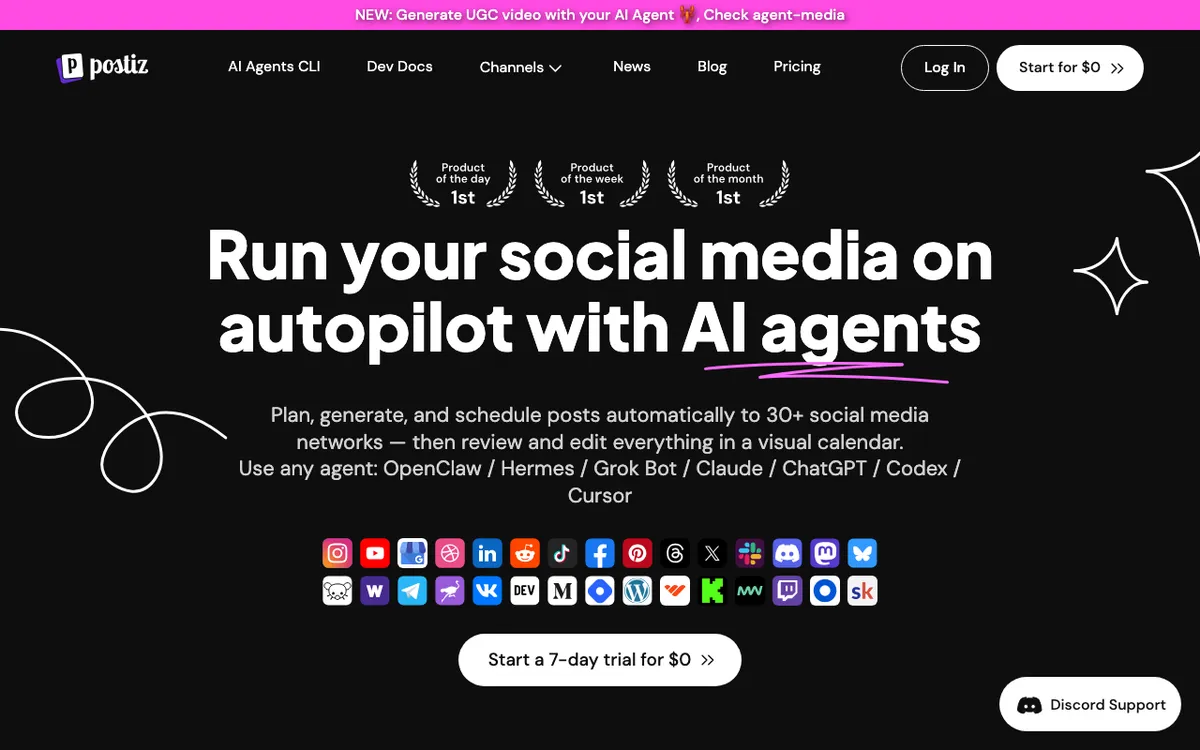
Self-hosted Postiz is the only genuinely fee-free route to programmatic publishing at any account count, and for some teams, regulated industries, agencies whose contracts forbid third-party data processors: it's the only architecture that clears legal. You get a real scheduler with an API and dashboard, running entirely on your metal.
Price it honestly, though, because the invoice is denominated in hours. The platforms don't grant API access to software; they grant it to reviewed developer apps and standing those up means Meta's App Review (advanced permissions, screencasts, business verification), TikTok's separate content-posting audit, and a dozen smaller bureaucracies, each with rejection loops. Then platforms change their APIs and your fork needs patching. A competent team absorbs this; a solo founder billing their time at anything above zero usually discovers the hosted options were cheaper. The ~$29/month cloud tier exists precisely for that discovery.
Pros
- +Zero marginal cost per account, forever
- +Full data ownership: the only architecture some client contracts allow
- +Real product with dashboard included, not just an API
Cons
- −Every platform's developer-app process is yours: Meta App Review, TikTok's content-posting audit, X's API tiers, weeks of lead time, recurring maintenance
- −Breaking platform-API changes land in your backlog (in our production experience, somewhere monthly)
- −No vendor to call when publishing breaks at 2am
Which one should you choose?
Indie hacker adding social publishing to a product
→ Breakreach. 2 accounts free, $5/account after, and the platform quirks you don't know about yet are already handled.
AI-agent builder (agents publish autonomously)
→ Breakreach or Zernio. Both ship hosted MCP + agent-readable docs; Breakreach's recoverable errors suit agent loops, Zernio's breadth suits fleets.
Agency platform managing 100+ client accounts
→ Zernio. $1/account above 100 is unmatched; ads APIs close the client-service loop.
Funded B2B product with enterprise buyers
→ Ayrshare. Vendor maturity, white-label depth and SLAs your customers' security teams will ask about.
Data-sovereignty or regulated environment
→ Postiz self-hosted. Only fully self-owned architecture, budget the app-review tax.
How we chose
We integrated against each API's documented endpoints (and ran real publishing through those we operate), audited what platform edge-cases are handled server-side versus deferred to the caller, tested MCP servers with a live agent, and modeled all-in monthly costs at 2, 10, 25, 100 and 500 connected accounts from published September 2026 pricing.
The verdict
Start where the prototype is free: Breakreach and Zernio both give you 2 accounts at $0 and an afternoon to first published post. Choose between them by trajectory, under ~25 accounts and/or agent-driven publishing favors Breakreach's handled edge-cases and $5 rate; fleet scale, ads, or exotic platforms favor Zernio. Graduate to Ayrshare when enterprise buyers enter the picture, and to self-hosted Postiz only when sovereignty demands it and you've priced the review tax.
Frequently asked questions
What's the cheapest social media API to start with?
Breakreach and Zernio both offer 2 connected accounts free with no time limit, enough for development and small production use. Ayrshare's free tier is development-only. Self-hosted Postiz is fee-free but costs platform-credential setup time (typically weeks across the major networks).
Do these APIs handle platform app reviews (Meta, TikTok)?
The hosted providers do: that's a core part of the value. Ayrshare, Zernio and Breakreach publish through their own audited platform apps, so you never touch Meta App Review or TikTok's content-posting audit. Self-hosting Postiz puts every one of those reviews on you, including their renewals and rejection loops.
Can AI agents use these APIs directly?
Increasingly, yes and it's becoming the main differentiator. Breakreach and Zernio ship hosted MCP servers (agents discover and call tools without custom glue) plus OpenAPI specs and llms.txt files agents can read to self-integrate the REST surface. Ayrshare has an MCP layer over its established API. Error-message design matters more than usual here: agents recover exactly as well as the errors let them.
How does scheduling work through an API?
You POST content with a timestamp, or ask for the next free slot on services with posting-schedule support and the provider publishes server-side at that time, retrying transient platform errors. Your application never runs a scheduler or needs to be online at publish time. Verify media handling too: good providers re-host your media URLs at schedule time so the post can't 404 later.
What about Buffer's API?
Buffer's public API has been effectively closed to new integrations for years and its capabilities lag every option here. Whatever your nostalgia, don't anchor a 2026 project on it.
Which platforms are hardest to publish to programmatically?
TikTok (strict media specs, separate audit for public posting, photo/video rules that differ), Instagram (professional accounts only, container-then-publish flow, 60-day token cycles) and Reddit (per-community rules like required flairs, karma gates) cause the most integration pain. It's exactly where the providers differ: check our capability matrix for who handles what automatically.
Try the AI-native way
Breakreach connects Claude & ChatGPT to 12 platforms · 7-day free trial
Get started free